researcher@authorized-scope:~$ inspect authenticated-smtp-private-network-oracle
Authenticated SMTP Test Function Exposes a Private-Network TCP Oracle
A sanitized report showing how an authenticated SMTP test feature exposed loopback and RFC1918 connection states through timing and error-class differences.
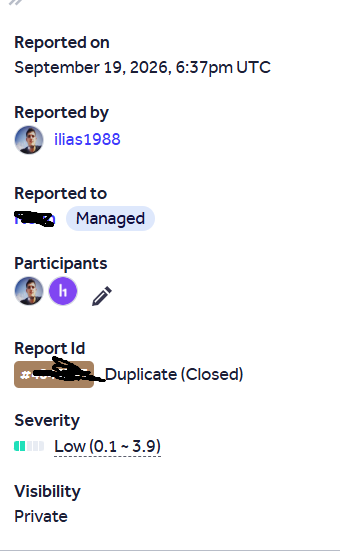
- Outcome
- Duplicate — Closed
- Severity
- Low
- Finding type
- Blind SSRF / SMTP reachability oracle
- Testing date
- 19 September 2026
- Published
- 21 September 2026
- Disclosure
- Sanitized
Sanitized disclosure. The target, domain, endpoint, report identifier, project and branch identifiers, email addresses and authentication material have been removed. Only controlled loopback and RFC1918 measurements are retained.
Executive summary
An authenticated SMTP test-email feature allowed a project administrator to choose an SMTP hostname while restricting the destination port to a small approved set. Host validation did not prevent loopback or private-network destinations. Timing and error details exposed whether the backend received an immediate connection refusal or waited for a timeout.
The result was a constrained internal TCP oracle. It did not provide SMTP banner content, email delivery, authentication material or access to another tenant.
| Field | Value |
|---|---|
| Access required | Authenticated project administrator |
| Input | SMTP hostname and an approved SMTP port |
| Allowed ports observed | 465, 587, 2525 |
| Observable signal | Timing plus normalized error class |
| Submitted severity | Low |
| Final program state | Duplicate — Closed |
Affected workflow
The feature sent a test email using project-supplied SMTP configuration. The public endpoint is intentionally withheld; its sanitized request shape was equivalent to:
POST /api/[redacted]/projects/{OWNED_PROJECT}/branches/{OWNED_BRANCH}/send-test-email
Content-Type: application/json
Authorization: Bearer [redacted]
X-CSRF-Token: [redacted]
X-Bug-Bounty: ilias1988

{
  "smtp_host": "127.0.0.1",
  "smtp_port": 2525,
  "recipient": "[researcher-owned-address]"
}
Only the researcher’s own project, branch and email account were used. The request did not attempt SMTP authentication and no message was delivered through an internal service.
Methodology
Three destination forms were chosen to test separate validation and connection paths:
- Literal loopback address
127.0.0.1on allowed port2525. - Public DNS hostname
127.0.0.1.nip.io, which resolves to the same loopback address. - Unresponsive RFC1918 address
10.255.255.1on the same port. - Port
25as a negative control because it was outside the accepted SMTP port allowlist.
Each accepted destination was sampled exactly three times. Status code, elapsed time, normalized response body and resolved-address disclosure were recorded.
Observed evidence
| Test case | Samples | Median | HTTP/result class |
|---|---|---|---|
127.0.0.1:2525 |
3 | 1.688 s | HTTP 200, immediate ECONNREFUSED |
127.0.0.1.nip.io:2525 |
3 | 1.436 s | HTTP 200, resolved to loopback, immediate refusal |
10.255.255.1:2525 |
3 | 11.514 s | HTTP 500, connection timeout class |
127.0.0.1:25 control |
1 | Not applicable | HTTP 400 before connection handling |
The loopback variants returned quickly and disclosed that the resolved target refused the connection. The RFC1918 test waited for the network timeout. The disallowed-port control confirmed that the application performed port validation before opening a connection.
Why this forms an oracle
The response distinguished at least two backend network states:
selected host:port
├── immediate refusal → fast response + ECONNREFUSED class
└── no response       → delayed response + timeout class
An authenticated administrator could therefore test selected hosts on the three allowed ports and infer connection behavior from a network position unavailable to an external client.
Security impact
The practical impact was limited internal network reconnaissance across administrator-selected SMTP ports. Error detail also revealed the post-resolution address and connection result, increasing the quality of the oracle.
The requirement for project-administrator privileges and the fixed port allowlist reduced the attack surface, which is why the report was submitted as Low.
Recommended remediation
- Resolve the SMTP hostname and reject loopback, private, link-local, multicast, reserved and non-routable addresses for IPv4 and IPv6.
- Validate the resolved address immediately before connection and prevent DNS rebinding between validation and use.
- Restrict the SMTP worker’s outbound network access to approved public destinations.
- Remove resolved IPs and low-level socket errors from user-visible responses.
- Use uniform timeout behavior and generic messages so refusal and timeout states are not distinguishable.
- Rate-limit configuration tests and alert on repeated changes across multiple hostnames.
Program outcome
The duplicate result does not change the technical evidence. It means the issue had already entered the program’s remediation process before this submission arrived.
Final response evidence
The screenshot below documents the final duplicate classification with the target and report identifier redacted.